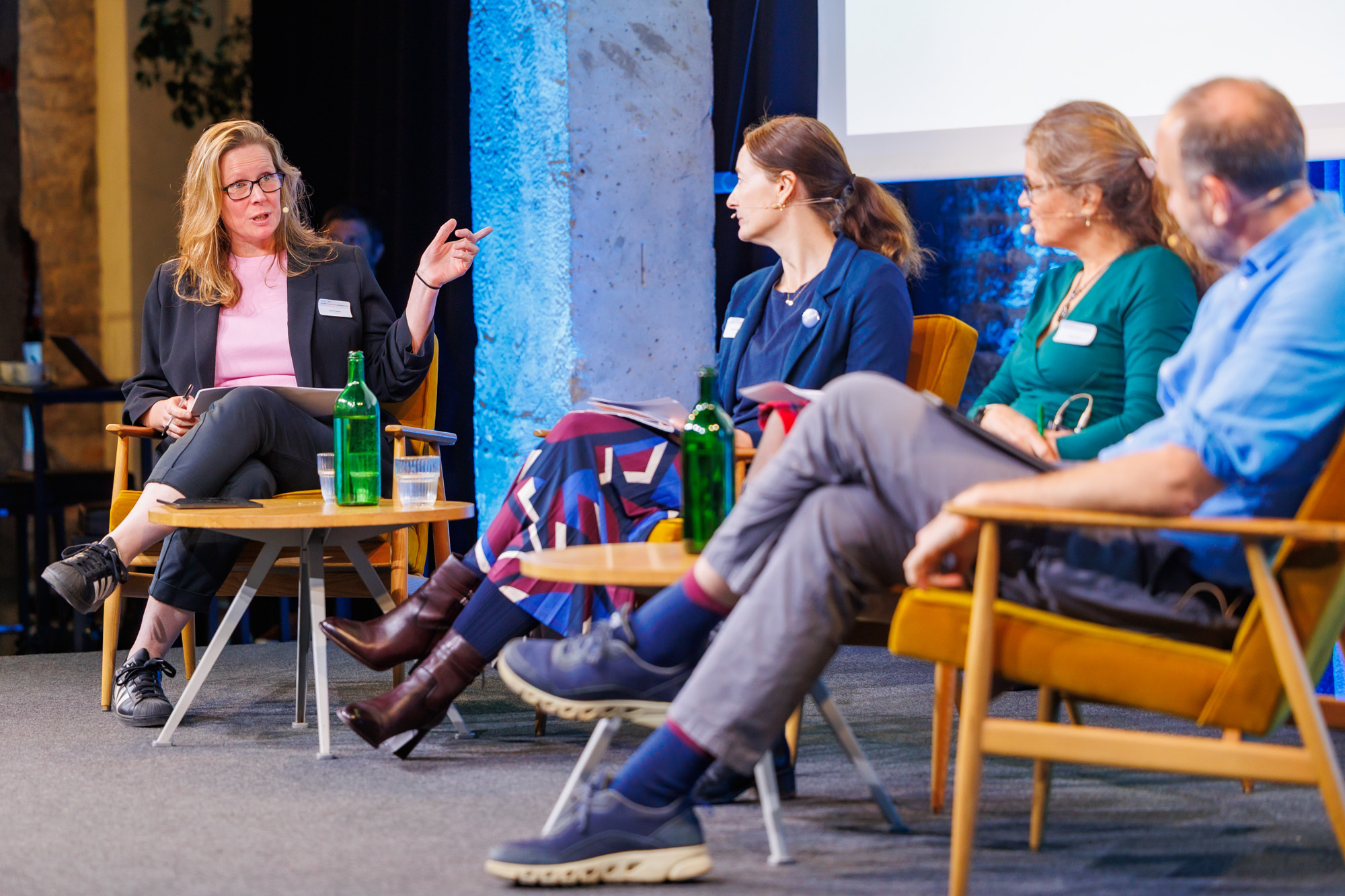
On 5 November, the Estonian Refugee Council’s fourth Tallinn Humanitarian Conference brought together nearly 120 participants and humanitarian experts from various countries at Fotografiska. Discussions focused on who holds power over humanitarian funding, data and decision-making, and whether funding cuts are forcing the system to undergo meaningful change or simply become smaller.
In his opening remarks, Eero Janson, Director of the Estonian Refugee Council, recalled that international humanitarian funding fell by approximately 30% between 2022 and 2025. “We have become very good at discussing priorities. But for someone whose food assistance is cut off or whose healthcare facility closes, these choices are not abstract. Budgets are political choices. The same applies to which crises receive attention and which programmes are quietly discontinued,” said Janson. He stressed that discussions about the funding crisis must also address who makes decisions that affect other people’s lives, who controls the data of people in need, and who bears responsibility and risks in cooperation between organisations.
Juliet Parker, Director of ALNAP, presented the latest report, The State of the Humanitarian System 2026. According to the report, UN-coordinated humanitarian assistance reached an estimated 38% of people in need in 2025, while 65% of respondents in ALNAP’s aid recipient survey said they were satisfied with the quality of the assistance they received. Parker emphasised the need to preserve effective approaches, rebuild trust, implement meaningful change and work with broader support systems. She also highlighted the growing security threats faced by humanitarian workers.
In the first panel, Reform or Regression? The Future of Humanitarian Aid after the Reset, Freddie Carver (ODI), Cate Turton (CALP) and Maria Groenewald (VOICE EU) discussed how the future of humanitarian aid depends less on producing new reports and guidelines than on putting existing knowledge into practice. According to CALP Network studies, 85% of people in need prefer cash assistance, yet only 20% receive it. The panellists discussed how to close this gap and direct more funding towards effective solutions. They also stressed that humanitarian principles must remain the foundation of the sector’s work. The panel was moderated by Juliet Parker (ALNAP).
The second panel, Consent in the Food Aid Queue? Data Protection and Power in Humanitarian Aid, explored data protection and privacy in humanitarian action. Irwin Loy of The New Humanitarian highlighted the risk of reducing people to data points and stressed that humanitarian organisations must critically assess what data they collect from people in need, how it is protected and whether people have control over its use. The panel featured Irwin Loy (The New Humanitarian), Marwa Fatafta (Access Now, MENA region) and Jos Berens (OCHA CHD). It was moderated by Eero Janson (Estonian Refugee Council).
The day concluded with the panel Partners, Leaders or Subcontractors? Rethinking the Division of Labour in Humanitarian Aid, featuring Sema Genel Karaosmanoğlu (Support to Life), Gry Ballestad (NPA) and Jeremy Wellard (ICVA). The panellists emphasised that cooperation between local and international organisations is far more complex than the often-used opposition of “local or international” suggests. Complementarity can take many forms, including access to crisis-affected areas, the distribution of funding and the roles of different actors. National organisations may not always be sufficiently close to local communities either. The discussion highlighted the importance of strengthening existing structures and networks rather than continually creating new ones. The panel was moderated by Liana Khorovytska (Estonian Refugee Council).
Nearly 120 people attended the conference at Fotografiska.
The event is supported by ESTDEV – the Estonian Centre for International Development.