- We have supported a total of 810 people across five oblasts in Ukraine with emergency livelihood assistance since February.
- Since 2022, more than 14,500 people with refugee backgrounds have taken part in our adaptation trainings in Estonia.
- In Tartu, 52 young people and older adults with refugee backgrounds came together during our project to strengthen intergenerational connections through shared activities and support newcomers' integration.
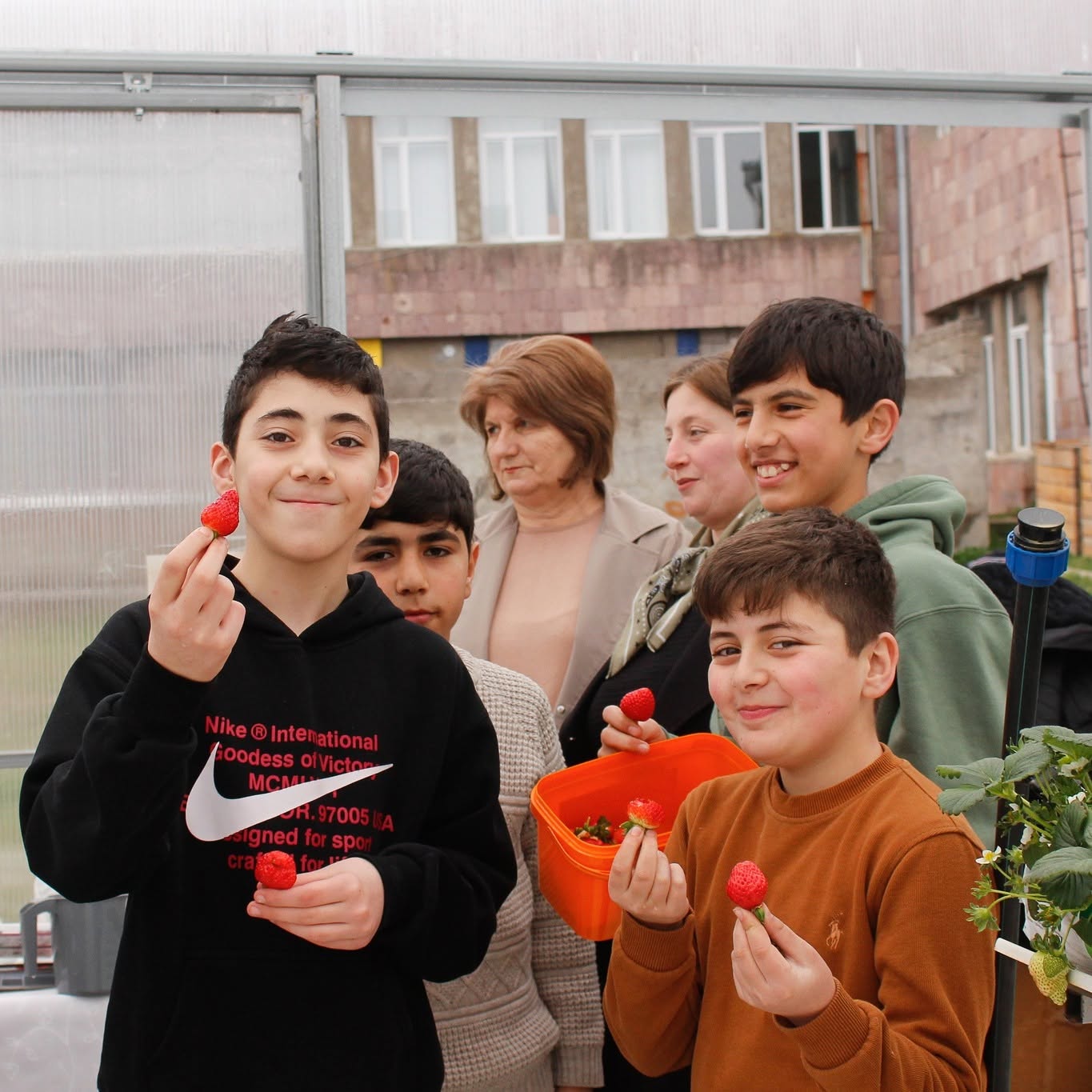
- In Armenia, our project was completed that introduced Estonian-developed water- and energy-efficient agricultural solutions in the hydroponic greenhouses of three schools in the Tavush region. The project helped improve the schools' food security, support climate change adaptation, and promote environmental education and students' interest in agriculture.
- By the end of June, in Lebanon we had distributed 16,800 hot meals, 50 ready-to-eat food parcels, and 100 essential aid parcels.
- We are building the DigiCap network of experienced digital specialists to address challenges related to digitalisation in the humanitarian sector and to support humanitarian organisations in improving the efficiency of their work in complex crisis situations. DigiCap is supported by Luxembourg Aid & Development.
Ukraine
We provide cash assistance, which allows people affected by the war to purchase food, medicines, hygiene products, and other essentials. In June, we assisted more than 1,900 people. As of now, we have provided cash-based assistance to more than 339,300 conflict-affected people. Cash assistance is provided for 3–6 months. Registration is carried out through Estonian Refugee Council's local registration points or via the online application platform. Currently, our focus is on assisting those in need in frontline areas in Zaporizhzhia, Kharkiv, Sumska, Dnipropetrovska, Mykolaivska and Odeska and Kherson oblasts. The programme is supported by the European Union, the US Government, the Ukraine Humanitarian Fund, and the Estonian Ministry of Foreign Affairs. The Estonian Refugee Council is the lead partner for the European Union funded project, while Acted is the lead for the US Government funded consortium.
We support livelihood activities related to agriculture, livestock, food production, and various services through emergency assistance, with the aim of strengthening people’s self-reliance. The support amount is around 700 euros. In June we shared 108 grants across five oblasts: Kharkivska, Dnipropetrovska, Poltavska, Kirovohradska, and Cherkaska. Since February, we have shared nearly 810 grants altogether. The programme is funded by the European Union and the US Government.
We run entrepreneurship programmes to help people affected by war create sustainable sources of income for themselves. We support new and existing businesses in Poltava, Cherkasy, Dnipro, Kirovohad, and Kharkiv oblasts. In June, we gave out 35 business grants, as of today, we have distributed a total of 342 grants for both existing and new businesses. The project is developed in partnership with Acted and supported by the US Government.
In Estonia, we ran a Mother's Day fundraising campaign in spring to support evacuation centres in Ukraine. The funds raised help provide newly arrived families with essential relief items and keep children's spaces operating, offering support and a sense of safety during an extremely difficult time. Thanks to our donors, we raised €2,000.
Estonia
Through the Language Ladder programme, we support Ukrainian refugee youth in language learning and social integration. In June, a social media workshop led by Ukrainian influencer Darya Pastak took place in Tallinn, where young people explored digital identity, the opportunities and risks of social media, and how to use an online presence to support their personal and professional development. Weekly practical Estonian language groups continued in Pärnu, while catch-up Estonian language classes for lower secondary school students took place in Kohtla-Järve and Tallinn. By the end of June, the adult Estonian language group in Jõhvi had concluded. As part of the project, we also deliver the MindSpring group-based mental health support programme for young people with a refugee background, helping them adapt and build resilience in their new environment. The MindSpring groups in Jõhvi were completed by the end of June. Read more about the first quarter of 2026 and the “invisible language learning” methodology used in the project on the Estonian Refugee Council’s website. The project is being implemented in collaboration with Tallinn University and the Polish organisation Dobra Fabryka. Funded by the European Union. Views and opinions expressed are however those of the author(s) only and do not necessarily reflect those of the European Union or European Social Fund Agency. Neither the European Union nor the Granting Authority can be held responsible for them.
The refugee youth-led project Youth Pulse has been launched, focusing on building a community in Tartu where both young people and older residents come together. Through a range of activities, the project develops and strengthens intergenerational relationships to help newcomers adapt more easily. In June, we organised book club and board game evenings, giving participants the opportunity to share reading experiences, discuss a range of topics, play games together, and make new connections. A total of 52 people took part. Funded by the European Union. Views and opinions expressed are however those of the author(s) only and do not necessarily reflect those of the European Union or the European Education and Culture Executive Agency (EACEA). Neither the European Union nor EACEA can be held responsible for them. The project is supported by the Estonian Agency for Erasmus+ and the European Solidarity Corps from the Erasmus+ programme.
We conduct monthly adaptation support training sessions on various subjects, including use of e-services, parenting, education system, adaptation of pensioners, legal matters, entrepreneurship, medical and social system, labour market, as well as legal foundations and residence permits. In June, 122 people took part in our training sessions. The most popular were our new workshops on artificial intelligence, which introduced the fundamentals of AI and explored how modern AI tools can support everyday life and integration in Estonia. These were followed by legal information sessions covering the extension of temporary protection, as well as the rights and opportunities associated with different residence permits in Estonia. Since 2022, more than 14,500 people have participated in our training programme.
We organise regular group activities and community events across Estonia. In June, the first cohort of this year's language cafés in Tallinn came to an end, while the Language Roulette programme continued to bring together Estonian speakers and people with a refugee background for informal language practice. Our active programme for older adults also continued, providing a safe and welcoming space for socialising, sharing experiences, and gaining practical knowledge. With support from donations collected among members of the British-Estonian Chamber of Commerce, we continued organising activities that strengthen community connections and support the integration of people with a refugee background. At the end of June, participants spent a day exploring the beautiful natural surroundings of Äksi, walking around the lake, enjoying its beaches, and visiting the historic Äksi Church. Together with local residents, they also joined a guided tour of Tartu Town Hall as part of Tartu City Day celebrations, offering an opportunity to practise listening to Estonian while learning about the city's history and culture.
In cooperation with the Integration Foundation, we are giving seminars to strengthen the capacity of local governments in the fields of migration and integration. In 2026, seminars took place in Haapsalu, Pärnu, Võru, Valga, Kärdla, Põlva, Põltsamaa, Kuressaare, Tallinn and Tartu. Cultural sensitivity training sessions have been held in Pärnu, Tallinn and Tartu. In total, 14 seminars and training sessions have been carried out across Estonia in the first half of the year. The project is co-funded by the European Union through the Asylum, Migration and Integration Fund (AMIF) and the Ministry of the Interior.
In cooperation with the Integration Foundation, we began organising various events across Estonia to increase the civic engagement of third-country nationals, including beneficiaries of international protection. The aim is to strengthen mutual understanding and trust, and to help third-country nationals cope better with everyday life and participate more actively in society. In June, we visited Setomaa, where we explored local culture and traditions. Together, we learned how to make sõir (a traditional Seto cheese) and tried our hand at Seto dancing. Project no. AMIF.1.02.23-0005 “Cooperation activities to increase the civic engagement of third-country nationals, including beneficiaries of international protection” is co-funded by the Asylum, Migration and Integration Fund (AMIF).
As part of the Refugee Councils United for Youth project, we are developing international cooperation in youth work with the Finnish Refugee Council, the Irish Refugee Council and the Danish Refugee Council’s youth organisation. The aim of the project is to strengthen the capacity of refugee councils in different countries to involve young people with refugee backgrounds in their activities, thereby increasing their civic engagement. In June, a joint learning visit for partners took place in Tallinn. An overview of the study on youth engagement and sense of belonging, conducted in winter, is available on the Estonian Refugee Council’s website. The project is funded by the European Union’s Erasmus+ programme.
We provide counselling by appointment at the Estonian Refugee Council office (Vambolo6, Tallinn) every day from 10 am to 5 pm. Our information hotline is open to all refugees, as well as institutions and individuals assisting them, at +372 5881 1311 (Monday to Friday from 10 am to 5 pm), and via email at counselling@pagulasabi.ee.
Armenia
In June, we concluded a project, bringing water- and energy-efficient agricultural solutions developed in Estonia to hydroponic greenhouses established at three schools in the Tavush region. We supported schools in adapting to climate change and ensuring food security in water-scarce conditions. Additionally, we promoted children’s environmental education and increased students’ engagement in agricultural and environmental topics. Read more about the programme on ERC’s website. The programme is funded by the Ministry of Climate of the Republic of Estonia.
Thanks to funding from the European Union, we have launched four community councils so people with refugee backgrounds can voice their concerns and take part in decision-making processes that affect them. In June, the Yerevan, Gyumri, Dilijan, and Yeghegnadzor groups carried out their regular activities. Additionally, groups are now implementing initiatives, one of them is targeting displaced people and local people with disabilities, raising awareness of their rights and helping identify opportunities in a more accessible way. There are also initiatives that have recurring activities, such as weekly skill development sessions. In June, 10 people were selected for funding from the Masis and Martuni self-help groups. Two new self-help groups were launched in Sevan and Goris. Mentorship activities continued, sessions ended in Dilijan and Hrazdan. We carried out monitoring visits in Artashat and Hrazdan. The programme is funded by the European Union.
We aim to strengthen Armenia’s green business ecosystem and promote circular economy principles through non-formal entrepreneurship education in public schools. Together with partner organisations, an agribusiness education game and extracurricular learning module will be developed, piloted in schools, and promoted for nationwide use. The project will introduce game-based learning methods, improve environmentally sustainable entrepreneurship education, and strengthen the capacity of education providers to deliver it. The programme is funded by ESTDEV – Estonian Centre for International Development.
Lebanon
The Estonian Refugee Council launched a humanitarian aid response in Lebanon in cooperation with the local organisation Nusaned, in order to ease the deepening humanitarian crisis caused by the armed conflict and to support people in the most vulnerable situations. We will distribute hot meals, food parcels and essential basic items to internally displaced people, particularly families with children, older people and people with disabilities. By the end of June, we had distributed 16,800 food portions, 50 ready-to-eat food parcels, and 100 kits containing core relief items. The programme is supported by the Estonian Ministry of Foreign Affairs.